A Life Of Death, Book One - Weston Kincade

alifeofdeath.jpg

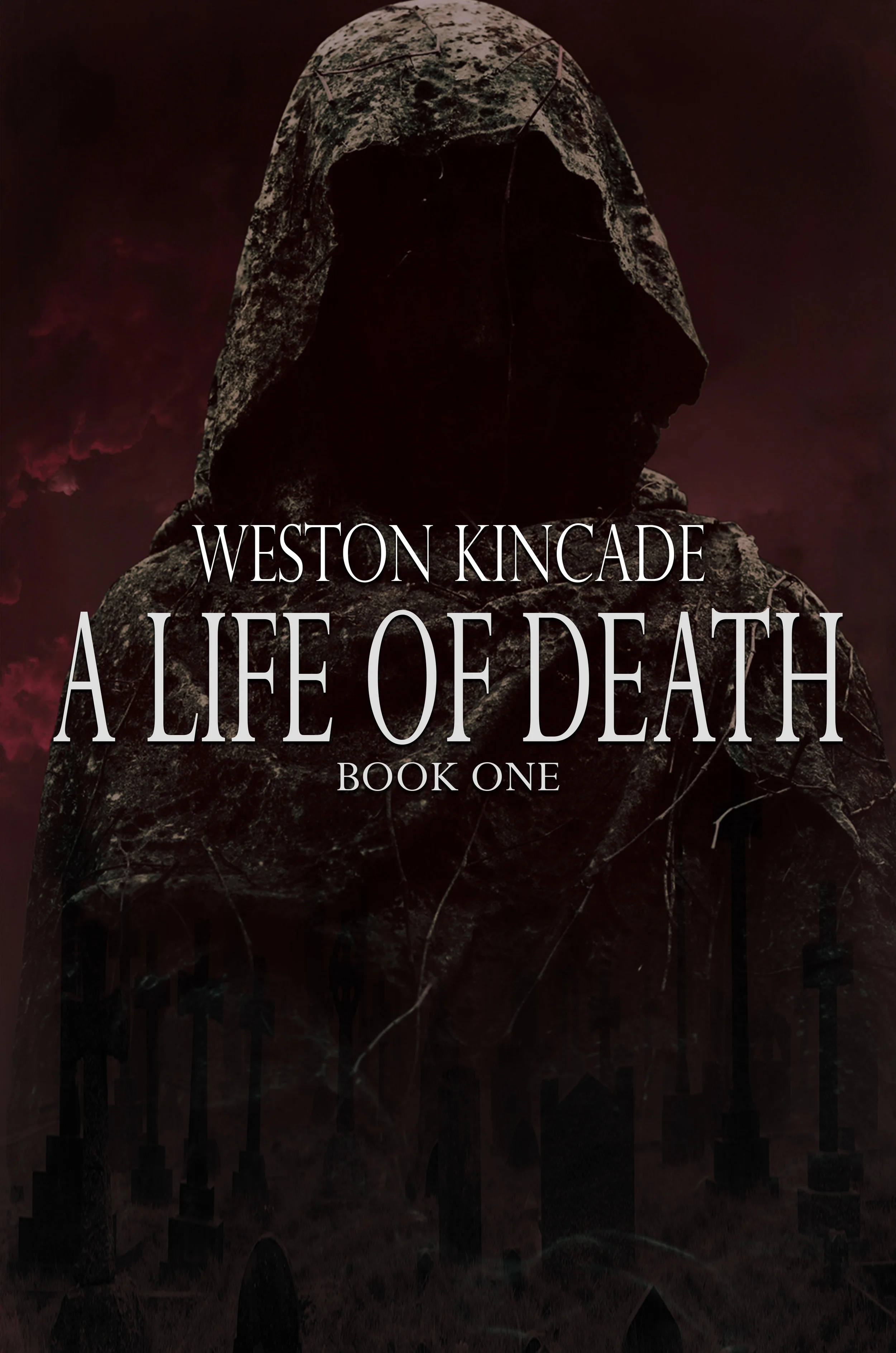
See that cover right next to this text? 

That cover screams: "Emma, do NOT read this book". It looks scary and like a lot of people will have a very gruesome and horrible death.

However, luckily for me, I read the blurb of this book that was send to me by author Weston Kincade. And that blurb didn't sound bloody and terrible - it sounded like this was a fascinating story about a boy with a special talent. His talent? Seeing people's death when he touches an object the deceased touched while dying - anyone still with me?

A Life Of Death is a mysterious and exciting book. Alex is a teenager who is suddenly confronted with this new talent. He confides in his friend Paige and his local pastor, who both tell him that he should use his talent to help people.

So how exactly do you help people with a slightly creepy and totally unbelievable talent? Well, that's what the characters in this book need to figure out. 

And that plot is immediately the strength of the book - no elaborate love stories (though there are some romantic elements worked in), no high school drama to distract from Alex's mission - it's a very simple book which tries to solve the question: "How can you help someone with this power?".

That might make the book sound boring, but that is definitely not the case. There are many twists and turns in the plot, which kept me on the edge of my seat (fine, bed - who reads on a chair anymore?) and urged me to keep reading and reading. I can't say too many things about them, because I don't want to spoil the plot for future readers, but trust me - the first 187171 things are not what they seem. At all.

Alex is the narrator of the book and the one through which we see how a variety of people died. He's a kid that had all the bad luck of the world thrusted upon him: his dad died, his stepdad is an prick, his mother has no backbone and his stepsisters are like strangers to him. We can't help but feel bad for him and to support him through his journey.

The problem I had was with Paige, Alex's friend and, I guess this doesn't spoil toooo much, romantic interest. Paige and Alex are pretty close, so it's not weird that he decides to tell her about his powers. What is weird is that she's totally understanding of it. The guy says he can see how people died and with one piece of proof (that he could have totally looked up), she believes him AND starts to help him in his plan to save people.

I'm all for crushes and I realise that teenage romance can be quite obsessive - as in "I believe everything you say and I'll do whatever you want, because I'm 16 and madly in love with you". But Paige seems like a really intelligent girl - Alex is smarter than Ron from Harry Potter, but Paige is still clearly the Hermoine in the group. She comes up with ideas of how to help people, she guides him through those ideas and she catches him when everything falls down.

So why does she believe him so quickly? I don't know - I guess she's still young and naive. However, when you put that small detail aside, she is a very likeable character. It is nice to see a book that's centred around a boy, but has the girl emotionally save the boy the whole time. It was about time YA stopped being all about the boy saving the girl. I can't wait to see if the author continued this theme in the other books of the series.

A Life Of Death is a short and very exciting read. The writing style works for the kind of story it is - it's straight forward and action packed, just like the plot. There is originality in the strength of the female side-character and that's enough reason that any YA lover should pick up this book.

Love Letters To The Dead - Ava Dellaira

We go through life constantly wondering why other people’s lives are so much better. This person has a better job, that one looks better and that girl has way more money. There is constant envy and sometimes we need to be reminded that envy can be very misplaced.

loveletterstothedead.jpg

That’s what a book like Love Letters To The Dead can do. Its story shows that we might think everyone else is perfect, but every single person has issues and problems he or she has to deal with. Unfortunately, I ended up wishing that an other author had grabbed the opportunity to write about this very important topic.

Laurel, the main character of Love Letters To The Dead, gets a simple English assignment on her first day in high school: Write a letter to a deceased person. But instead of writing a generic assignment, Laurel discovers that writing letters to famous dead people is the best form of therapy for her. Her letters become a diary, sharing experiences in her life that somehow remind her of the deceased person. She writers about her dead sister, May, and the guilt she feels revolving her death. She writes about Sky, the cute guy in school, and about her mother, who moved to California after the death of May.

The letters start off pretty basic - like reading the diary of an average 16 year old. However, as the school year gets more difficult, the letters show more and more of the problems Laurel is experiencing. What exactly happened to her sister the night she died? Why did her mother leave? Will she ever be able to open up to Sky?

Because every chapter is a letter, there is a very nice and original pacing to the story. When Laurel writes to Kurt Cobain she discloses different things then when she writes to Amelia Earhart. Each person inspires her to open up about certain subjects and that’s what makes this book a good read. Laurel starts off as your typical teenage girl, but letter by letter it is disclosed that she has experienced a lot more than a normal teenage girl has. Added to that, everything is not just in her narrative, but “written by her” - there is some amazing insight into her personality. She, along with the reader, finds out that things are often not what they seem and most importantly, that people are not what they seem.

Besides the accurate representation of Laurel, the other characters in the book are also diverse and work in the theme that “everyone has issues”. Laurel’s sister May turns out to have had some rough experiences and boyfriend Sky has some family issues. All these problems are again exposed throughout the book in a very subtle, but useful way.

However, besides all of that, I still struggled with the basic writing style of this book. I understand that Laurel is writing the letters and that she’s a teenager, so she can’t be too sophisticated, but she’s a really intelligent teenager. One who is obsessed with poetry. Why are her letters so bland and boringly written? It’s all straight to the point and it just didn’t captivate me. Reading this book is kind of like watching Dr. Phil on repeat all day - it’s drama (good drama in this case though), but presented in such a bland way. I want to read more from Ava Dellaira to find out if this writing style was a creative decision or if this is just the writing style she always uses. 

For example, the most liked quote of this book on Goodreads (121 likes and spoiler-free!):

“I think a lot of people want to be someone, but we are scared that if we try, we won't be as good as everyone imagines we could be.” 

The messages in this quote? Great and again emphasises the theme, but come on. This looks like a quote someone threw on pinterest, not one in an amazing book. It’s cliché and overdone and bland.

Love Letters To The Dead has all the potential in the world to be one of the best YA books out there - the summer hit of 2014. However, the boring writing style just didn’t do it for me. Whether it was a decision to make Laurel’s writing basic or whether it is the style of the author, I’ll probably never know. But I kinda wish someone else ran with this idea and did it justice.

Websites that help you write better - internet is not always procrastination

As "unknown" once said: "Being a good writer is 3% talent and 97% not being distracted by the internet". 

Though I am not one to argue with internet wisdom, I have to disagree with this quote. I started writing a story yesterday and found out that the internet can be distracting in the best possible way.

No, I'm not talking about Twitter, Facebook or Pinterest. I'm talking about real websites that motivate and inspire writers - oh and they can help you jump some of the most annoying creative-process-hurdles. 

Character name generator for fun

If you're anything like me, you can struggle with finding the appropriate name for this very specific person you have in mind. Sometimes, a name just pops up. Usually, it doesn't. Instead of looking at baby name sites -confess, we all did it -  I found a better solution.

Ok, so "character.namegeneratorforfun" doesn't sound so professional, but this is by far the coolest name generator I have seen. You can select gender, heritage and country of residence and you get a name (first AND last name) to match all of those. Even better? You get an explanation of what kind of person your character would be with that name: characteristics, jobs, partners,... It's all there to inspire you. 

Synonym finder

All writes struggle with using the same words too much - when I was in Journalism school, my tutor would always circle the words I repeated over and over in my reviews and trust me, sometimes my paper was just one big circle. How to avoid this? Train yourself with a website like synonym finder.

It's easy to use - when editing your own story, you will notice those damn repetitive words, the ones that you just can't find a synonym for. Go online, type it in and find the synonyms and hypernyms (though I'm not sure why you would need that, but ok). It's a quick way to help you edit your story and to avoid sounding boring for your readers.

Word of the Day

Connected to the previous point, there is the problem you can have when wanting to describe something, but not being sure what word to use. You know you're character is loud and obnoxious, but those words just have the wrong connotation. So what is it? How about raucous - the word you just learned as your word of the day.

Dailywritingtips.com is filled with amazing tips for writing, but this one has to be my favourite. There is something excited about learning a new word and then being able to incorporate it in a story. Or if you're looking for writing inspiration - write a story revolving the word of the day. Both options will help you become a better writer.

31 ways to find inspiration for your writing

And finally, maybe the most tricky part of all - where do you find your inspiration on days when stories just can't seem to come to you?

On awesome lists like on writetodone. 31 easy ways in which to find inspiration, it's a list I look at at least once a month. It's a nice little boost to start writing again and to turn that laptop off!

And so many more...

These are just four of the writing sites I use most, but there are so many more out there. Tumblr is filled with writing tips and tricks and google "writing help" and you'll get million of hits. The internet really isn't all just distraction - it can also help you. (Just like this blog is helping me reach my nano camp word limit!)

Jane Eyre - Charlotte Brontë

There is such a fulfilling feeling after reading a classic. The feeling that you finally belong to a club that so many people already joined. Suddenly, a world of word-puns and movie-references open up to you.

"You're dating such a Mr. Rochester." "Haha, yeah..." (Wait, what? Who is Mr. Rochester? Was he our gym teacher in high school?)

Finally, I joined the club. I moved from the "I can never finish a classic"-club to the "I know what you mean with 'a Mr. Rochester'!"-club. It's a good feeling and the moment I finished Jane Eyre, I was elated and proud.

But then an eery feeling set it: Was I just elated because I finished the book and conformed to what society thinks I should read or because I finished a book that I actually really enjoyed?

In the case of Jane Eyre, it's hard to decide.

The outline of the story is well known to most people: Jane Eyre is an orphan who ends up as a governess at Thornfield Hall. The house is owned by Mr. Rochester, an older, and rather cold, gentleman. Through ups and downs, Jane and Mr. Rochester fall in love. But as always, things are not as simple as they seem.

When I started the story, I really got into it and fell in love with Jane. Her childhood is awful, but somehow Jane does learn how to stand up for herself. I even would say that she was a feminist, and just generally a humanist, for that time. 

Then Jane goes to a boarding school and I really got into the story. The characters she meets there are interesting and well developed. Especially Helen Burns, an older student who takes Jane under her wings, is forever a favorite of mine. Jane stays at the institute, Lowood, for 8 years and those 8 years fly by in the book. No unnecessary details, no boring blabbing, just plot element after plot element.

I loved it and I loved it even more when I discovered that this speed is kept throughout the whole second half of the novel too: the part where Jane arrives at Thornfield Hall.

Where I started to lose my patience with this novel, is the point where Jane decides to leave Thornfield for several, and way spoilery, events. She wanders around and God, reading it felt like I was wandering around aimlessly too. Too many descriptions, too much unnecessary conversation, too much like a Jane Austen novel. I must admit that I skimmed from this point on, until the last 30 pages, when a plot twist makes everything interesting again.

Jane captured my heart in this novel and, even though I despised Mr. Rochester, there is definitely something very romantic about this book. However, it just doesn't captivate me like so many other books do. Is it the old English? Is it because it's talking about such a remote world? Is it because Mr. Rochester was a bit of a prick? 

I think it was all of the above combined. Added to that, I often got lost in Jane's thoughts. She went back and forth about things so many times, that she confused me. This meant that I had to get out of the story and really think about what Jane was doing. I was judging Jane at times and I don't want to judge my protagonists - I want to enjoy them. I want to start reading and keeping going and going until I'm completely sucked in the story. Because of Jane's quirky ways of thinking, I just couldn't do that.

So who should read this book? Everyone, like myself, who wants to join the "I read classics"-book club. I've read Jane Austen, I've attempted to read Vanity Fair, but none of those books read as easily and entertaining as Jane Eyre. So I think this is a great book to get your feet wet in the classics. However there are so many books and our lives are so short - I wish I would have spend the time reading a book I truly enjoyed, instead of reading something because "everyone reads it". 

But that fulfilling feeling when ending these 400 pages? That was priceless and I would almost consider reading a classic again - just for that.


First day of Nano meets Craigslist

July 1st - a beautiful summer day. The start of the summer for many people. One of the busiest days at the airport.

For writers, the day that hell begins. Or, as hell prefers to be named, “nano camp”.

Can anyone in the world remind me why I signed up to do this?

I kind of forget about camp already, until late yesterday evening. And immediately, I decided to make some changes to my plan.

50,000 words? Not going to happen my friend. My goal is to write every single day, but to not pressure myself into a word count. Between blogging, reviewing, reading and subediting, I will not have enough time to reach the goal I wanted to reach. So I just want to motivate myself to write every single day, no matter how tired I am.

So today I continued working on a short story I made up with a friend. The prompt? Looking at Craigslist and making a story out of some of their ads. Here’s a little preview of what I’m working on.


He really shouldn’t have eaten that chicken masala before calling her. Flashbacks of 6th grade Indian Day go through his mind as he tries to not think about the stench of the restroom facilities after he quietly snuck out. He doesn’t really know what her job description entails, but he can make a safe bet that he doesn’t have enough money to make her clean up his poopy-pants. 

Poopy-pants? Really? You still think about poopy-pants, but yet you got yourself in this situation? Right, his situation. That needs sorting rather quickly, judging by the look on her face.

What was her name again

“Sorry, what was your name again? It slipped my mind,” he almost went for an innocent face, but then remembered the situation he was in. Innocent was definitely not appropriate here. Or was it?

“Honeybuns, you can call me whatever you want. Candy, Paulina, Victoria - if you’re into uptight Victorian shit.”

“Right, so.. Candy.”


Is it random? Definitely, but then what do you expect from Craigslist? Anyone else ever tried a prompt like this? How did it work out?

We Were Liars - E. Lockhart

We Were Liars might be the most hyped-up Young Adult book released this year. E. Lockhart has been praised by John Green and Scott Westerfeld for her haunting novel about the Sinclair family and Beechwood Island.

Usually when I write a review, I don’t like to include the opinions of other authors or reviewers. Obviously the book cover is going to boast how amazing the book is - it’s called marketing. However, We Were Liars is actually 10 times better than the review quotes claim it to be. Want to know why?

It starts of with the writing, which is so beautiful. I know beautiful is a meaningless and overrated word in reviews, but I’ll prove it. Take the opening sentences of the book:

Welcome to the beautiful Sinclair family.

No one is a criminal.

No one is an addict.

No one is a failure.

The Sinclairs are athletic, tall, and handsome. We are old-money Democrats. Our smiles are wide, our chins square, and our tennis serves aggressive.

Every creative writing class I took, focussed at least 5 lessons on characterisation and the narrative voice - this opening paragraph shows how to set a scene and give a sense of the narrator and her family.

This narrator is called Cadence and she’s the oldest grandchild in the Sinclair family. Each summer, the whole family (grandparents, three beautiful daughters and their children) meet on a private island. In Cadence’s “Summer 15” something goes horribly wrong and she wakes up at a hospital on the mainland without her memory. What happened in summer 15?

The journey of Cadence is the journey of retrieving her memory and learning that not everything is what it seems. As a reader, you feel bad for Cadence who is slowly learning that the opening paragraph of the book is the furthest thing from the truth. She is a teenager, just 17 when she tries to uncover the truth, who has to learn some horrible truths about her family and herself. How can anyone cope with it?

Cadence deals with it in a very mature and raw way. She didn’t read like a teenager to me, she analysed things and thinks everything through before she acts. I guess if you really want a teenage-y narrator, this is a negative, but I adored a more mature narrator. 

The plot takes twists and turns that completely threw me off every single time. You want to keep reading. You want to find out what happened in Summer 15 almost more than Cadence was to know.

Another bonus is the length of the book - 224 pages means that you don’t have to read for hours to find out what happens. There is definitely suspense and things don’t start to make sense until page 180, but the story is constantly moving and progressing.

We all know the pressures and expectations of belonging in your family, but if your family turns out to be complete strangers, what can you do?